
Brick Wall Problems Don’t Stay Small — Here’s What to Watch For
A no-nonsense guide to tuckpointing, repointing, masonry repair, and faux sandstone finishes in Sydney — from the mob who actually knows what they’re doing.
Let’s be real. Most Sydney homeowners don’t think about their brick walls until water starts dripping through the lounge ceiling, or a neighbour politely (or not so politely) points out that your fence looks like it survived the Blitz. By then, a simple maintenance job has turned into a rescue mission.
If you’ve got a Federation home in Newtown, a 1960s brick-veneer in Penrith, or a strata block somewhere between Parramatta and the CBD, your brickwork is working harder than you think — holding moisture at bay, keeping structural loads in check, and making sure your property looks like it belongs to someone who gives a damn.
This is your complete guide to tuckpointing in Sydney, repointing services, masonry repair, brick wall restoration, and why a faux sandstone finish might just be the smartest upgrade your home can get in 2025.
First Up — What Even Is Tuckpointing? (No, It’s Not Just Fancy Painting)
Tuckpointing gets thrown around a lot, but it’s actually a specific decorative technique with real functional benefits. Here’s the difference in plain English:
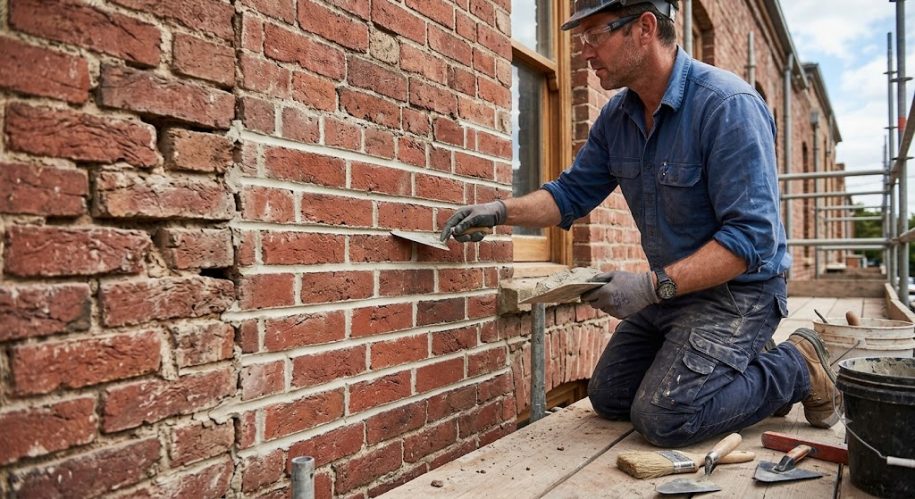
Repointing is the process of removing old, deteriorated mortar from between your bricks and replacing it with fresh mortar. It’s the maintenance backbone of any brick building. Think of it like re-grouting your tiles — except your tiles are load-bearing walls and the consequence of ignoring it is significantly worse than a mouldy bathroom.
Tuckpointing goes a step further. It’s a two-stage process where the mortar is matched closely to the colour of the brick face, then a thin, contrasting putty line is drawn through the centre to create the illusion of finer, more precise joints. It originated in 18th-century England as a way to make ordinary brickwork look like the expensive, finely-cut stuff. In Sydney, it’s still the gold standard for heritage restorations and period homes.
Both services are offered by the team at Sydney Tuckpointing & Rendering, who’ve been doing this across residential, commercial, and heritage properties throughout the city.
Why Should You Actually Care? The Signs Your Brickwork Is Crying Out
Your mortar doesn’t deteriorate dramatically overnight — it’s a slow, sneaky process that Sydneysiders often don’t notice until the damage is well advanced. Here’s what to look for:
- Crumbling or powdery mortar joints — run your finger along the joints. If mortar comes away easily, it’s failing.
- Visible gaps between bricks — mortar that’s fully recessed or missing entirely.
- Water stains on internal walls — moisture is entering through the mortar joints.
- White chalky deposits (efflorescence) — salt being pushed out by water moving through the masonry.
- Loose or bulging bricks — a structural red flag that needs immediate attention.
- Cracks following the mortar joints — the joints are failing, not the bricks themselves.
Here’s the thing: Sydney’s climate is not gentle on masonry. The combination of intense summer UV, coastal salt air (especially for properties in the Eastern Suburbs, Northern Beaches, and Inner West), and the thermal expansion-contraction cycle through our seasons accelerates mortar deterioration significantly. A mortar joint that might last 40 years in a milder climate can need attention in 20–25 years in Sydney.
Ignoring it is false economy. A full repointing job is a fraction of the cost of replacing structurally compromised brickwork or fixing water-damaged interiors. As a rule of thumb: repointing costs around $30–$60 per square metre in Sydney. Rebuilding a wall? Considerably more, and considerably more inconvenient.
The Tuckpointing & Repointing Process — Step by Step
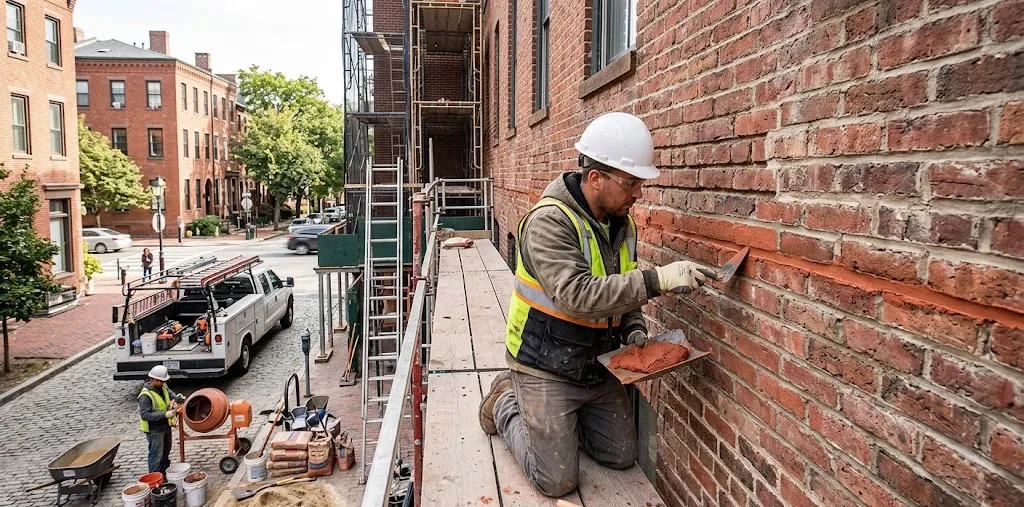
Wondering what actually happens when you book a tuckpointing and repointing service in Sydney? Here’s how a proper job unfolds:
- Inspection and Assessment
A qualified tradesperson inspects the mortar joints, identifies the extent of deterioration, checks for structural issues, and assesses the type of original mortar used. This last point matters enormously for heritage properties — using Portland cement mortar on an old lime-mortar building is a classic rookie mistake that can cause brick damage and spalling.
- Mortar Raking
Old mortar is carefully raked out to a depth of approximately 15–20mm using angle grinders, oscillating tools, or manual chisels. The goal is to remove all the compromised material without damaging the brick faces. This is where skill really counts — an inexperienced operator can chip bricks and make a mess that’s expensive to fix.
- Mortar Matching
Fresh mortar is mixed to match the colour, texture, and composition of the original. For tuckpointing specifically, two separate mixes are required — a base mortar that blends with the brick, and a contrasting pointing putty for the fine line.
- Application and Finishing
New mortar is applied in layers, allowed to cure to the correct firmness, then tooled to the appropriate joint profile. For tuckpointing, the fine putty line is then carefully drawn using a jointing tool. The result: crisp, defined joints that give the brickwork a sharp, architectural quality.
- Clean-Up
A light acid wash removes any mortar smears from the brick faces, leaving the wall looking fresh and clean.
The whole process can take anything from a day (small patch repair) to several weeks (full exterior of a heritage home). Scaffolding is typically required for walls above 2.4 metres, which adds to cost and planning time — but it’s non-negotiable for safe, quality work.
Masonry Restoration in Sydney — More Than Just Mortar
Repointing is often just one part of a broader masonry restoration service in Sydney. When professionals assess your property, they may also identify:
Spalled or damaged bricks — bricks that have started to flake or break apart, often due to water freeze-thaw cycles or incorrect mortar causing salt build-up within the brick itself.
Failed lintels and arch bars — the steel bars above windows and doors that support the brickwork can rust and expand, cracking the surrounding masonry.
Brick replacement — individual damaged bricks can often be removed and replaced with matching reclaimed bricks, which is far more cost-effective than people assume.
Facade cleaning — decades of urban grime, pollution deposits, and biological growth (lichen, moss) can be removed through careful cleaning techniques appropriate to the masonry type.
Waterproofing and sealing — for properties in particularly exposed locations, a breathable masonry sealer applied after repointing dramatically extends the life of the repair.
Sydney has a huge stock of Federation-era, Interwar, and post-war brick homes — particularly in the Inner West, North Shore, and Eastern Suburbs — that are reaching an age where comprehensive masonry restoration is becoming essential. Getting ahead of the deterioration curve protects both the structural integrity and the heritage character of these properties.
Brick Wall Repair Sydney — When Things Have Gone Beyond Maintenance
Sometimes the damage has gone past the point where repointing alone cuts it. Brickwork and mortar repairs in Sydney can involve:
Crack repair and stitching — structural cracks in masonry walls can be stabilised using stainless steel helical bars bedded into the mortar courses, restoring structural continuity without full wall replacement.
Partial wall rebuilding — sections of brickwork that have bowed, bulged, or partially collapsed (not uncommon in 100-year-old unreinforced masonry) can be carefully dismantled and rebuilt, often using the original bricks.
Chimney repairs — Sydney has thousands of disused chimneys that are quietly deteriorating at roofline level. Crumbling chimney crowns, failed flashing, and cracked flaunching are all repairable without removing the whole stack.
Rising damp treatment — masonry that’s sitting in contact with damp soil can wick moisture upward through capillary action, leading to efflorescence and internal damp. Chemical damp-proof course injection can address this.
The key with significant brick wall repair is catching it before it becomes a structural safety issue. In Sydney, where many properties sit on sloping blocks with substantial earth retaining walls, failing masonry isn’t just ugly — it can be genuinely dangerous.
The Faux Sandstone Finish — Sydney’s Best-Kept Renovation Secret
Here’s one that surprises a lot of people: you don’t have to pay for real sandstone to get the look of it.
Sydney and sandstone have a deep historical relationship. From the original convict-era buildings in The Rocks to the grand terrace houses of Paddington and Balmain, sandstone has defined the city’s architectural character for over 200 years. But natural sandstone is expensive to quarry, heavy to work with, and increasingly difficult to source in the consistent quality needed for new construction.
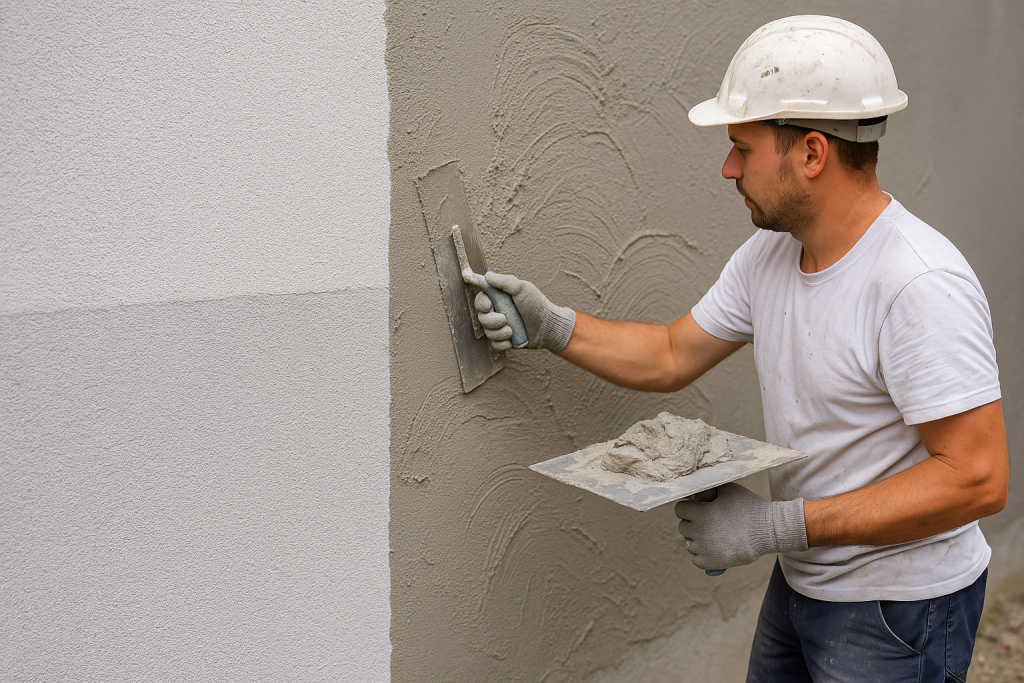
Enter sandstone imitation finishes — a specialist render technique that replicates the warm, textured appearance of sandstone on virtually any substrate. Applied by a skilled tradesperson, a quality faux sandstone finish is:
- Indistinguishable from the real thing at normal viewing distances
- Far lighter — no structural implications for the underlying wall
- Considerably cheaper — natural sandstone cladding can cost $200–$400/m²; a quality applied finish is a fraction of that
- More consistent — natural stone varies; an applied finish can be colour-matched precisely
- Repairable — damage can be patched invisibly, unlike natural stone where matching new to old is notoriously difficult
The technique involves specially formulated polymer-modified render systems applied over prepared masonry or render bases, worked with specialist tools and texturing techniques to achieve the characteristic grain, layering, and warm ochre palette of Sydney sandstone. The finish is sealed and UV-stabilised to perform in Sydney’s climate.
It’s a popular choice for extending heritage-character homes where matching original sandstone would be prohibitively expensive, for rendering rendered-brick homes to achieve a consistent stone aesthetic, and for retaining wall and fence treatments where real sandstone would be structurally complex.
Call us on 0452 522 232 for a free quote, or explore more masonry guides and tips on our blog.
Your walls have been patient long enough. Let’s give them the help they deserve.
What Do These Services Actually Cost in Sydney?
Let’s talk numbers, because everyone wants to know and half the industry is evasive about it.
Repointing: Generally $30–$60 per square metre in Sydney, with the national average running around $61/hour for labour. A typical Sydney terrace house might run $2,500–$6,000 for a full exterior repoint. Scaffolding, where required, adds significantly to this.
Tuckpointing: Slightly more than standard repointing due to the additional skill and materials involved in the two-stage finish. Budget 20–30% above standard repointing rates for heritage tuckpointing work.
Masonry restoration projects: Highly variable depending on extent of work. Minor brick repairs might start at $500–$1,000. A full masonry restoration on a Federation home can run $10,000–$30,000+ depending on the scope.
Faux sandstone finish: Variable by area and complexity, but typically $80–$150/m² for a quality applied finish — compared with $200–$400/m² or more for real sandstone cladding.
What drives cost up:
- Height and scaffolding requirements
- Heritage mortar matching complexity
- Extent of structural damage
- Access constraints (tight Sydney lots, anyone?)
- Volume and scale of work
The honest approach is always to get a proper site inspection and written quote. You can get in touch with the team here for a no-nonsense assessment of what your property actually needs.
Why Professional Masonry Work Matters — The Case Against the Bloke With a Bag of Cement
Look, Sydney has no shortage of people willing to slap some mortar in your joints for a cheap day rate. But here’s why that’s a gamble worth avoiding:
Mortar compatibility is genuinely technical. Using too-hard mortar on old lime-mortar brickwork forces movement stresses into the bricks themselves rather than the joints, causing spalling and cracking. This is an irreversible mistake. Matching mortar strength, composition, and movement characteristics to the existing construction requires proper knowledge.
Poor workmanship shows — forever. Mortar that’s applied too thick, joints that aren’t properly profiled, or lines that wander: it’s all visible from the street and it depreciates the property’s kerb appeal.
Structural issues can be missed. A trained eye during a masonry inspection catches lintel failures, wall tie corrosion, and rising damp early. A general labourer with a mixer does not.
Safety. Working at height on scaffolding, using angle grinders, handling acid washes — these are tasks that require proper site safety practices. Do you really want an unlicensed contractor on your roof in a harness that was last checked in 2019?
The experienced brick and tile specialists at Sydney Tuckpointing & Rendering bring qualified tradespeople to every project — people who’ve done this professionally across hundreds of Sydney properties.
How We Help — What Working With a Real Sydney Masonry Specialist Looks Like
If you’re reading this thinking “okay, I probably need to do something about my walls” — here’s what the process looks like when you work with professionals:
- Free site inspection and assessment — a qualified tradesperson visits the property, identifies what’s needed, and explains it to you in plain English (not trade jargon designed to justify a bigger invoice).
- Written scope and quote — you get a clear breakdown of what will be done, how, and what it will cost. No vague estimates that double by completion day.
- Scheduling and access planning — scaffolding, access equipment, and work sequences are coordinated to minimise disruption to your household or tenants.
- The work — executed by experienced, licensed tradespeople who give a damn about the outcome. The mortar is matched, the joints are clean and consistent, and the finished wall looks like what it is: a job done properly.
- Clean-up and aftercare advice — the site is left tidy, and you get practical advice on maintaining your masonry going forward.
Whether you need a quick mortar repair on a garden wall or a full heritage masonry restoration on a Federation home, the full range of services is covered — from the repointing and tuckpointing specialists through to complete masonry renovation and sandstone imitation finishes.
FAQs — The Questions People Actually Ask
How often does brickwork need repointing? In Sydney’s climate, mortar joints in exposed brickwork typically need attention every 20–30 years. Heritage properties with lime mortar may need more frequent maintenance. Sheltered internal walls can go much longer.
Can I repoint brickwork myself? Technically, yes. Should you? Probably not, unless you have masonry experience. The risks are mortar incompatibility causing brick damage, poor aesthetics, and missing underlying structural problems. For anything structural or heritage, always use a professional.
Does repointing add value to a property? Absolutely. Well-maintained brickwork significantly improves kerb appeal and eliminates moisture ingress, which is a major red flag in building inspections. For investment properties, it’s one of the better-returning maintenance expenditures.
Is tuckpointing the same as repointing? They’re related but different. Repointing is functional — replacing deteriorated mortar. Tuckpointing is a decorative refinement on top of repointing, creating the fine-line aesthetic. You can repoint without tuckpointing, but tuckpointing always involves repointing.
What’s the best time of year to get repointing done in Sydney? Autumn and spring are ideal — temperatures are mild, mortar cures evenly, and you’re not competing with the peak summer renovation rush. That said, properly managed masonry work can be done year-round.
The Bottom Line
Sydney’s older housing stock is a genuine asset — architecturally, historically, and in pure property-value terms. But that asset depreciates fast if the masonry holding it together is neglected.
The good news? This isn’t open-heart surgery. Tuckpointing, repointing, brick repairs, and even faux sandstone finishes are relatively affordable, relatively quick, and make a genuinely dramatic difference to how a property looks and performs.
Don’t wait until water is coming through the wall. Don’t wait until a crack becomes a structural problem. And definitely don’t hand it to the cheapest tradie with a mixer and a sunny Saturday afternoon.
Your walls have been quietly doing their job for decades. Give them a bit of expert attention — they’ve earned it.
👉 Explore the full range of services, check out the project blog, or reach out for a quote — the team at Sydney Tuckpointing & Rendering is ready to take a look.
Serving residential, commercial, strata, and heritage properties across Greater Sydney — from the Northern Beaches to the Sutherland Shire, Inner West to the Hills District.